
Orange County Recent Arrests
No single public list holds every Orange County arrest. The Orange County Sheriff-Coroner Department runs the county custody system. It also runs the inmate locator and an arrest-log service. The locator answers one question: who is in custody right now. The county frames its arrest log as a daily list. It covers people arrested or cited and released over the past 30 days. City police departments often keep their own logs before a person reaches county custody. That split matters. Someone cited and released may never land on a jail roster. A person booked and moved between county facilities can still sit in the locator. For official tools, the Orange County Law and Justice directory describes both the daily and 30-day arrest services. Some older links in it no longer resolve. The live entry point now is the OC Sheriff Public Services Portal. It greets visitors with an account sign-in gate. Expect to verify the portal's current options rather than trusting an old endpoint. Booking data shifts as cases move.
| Official view | Window and purpose | Key limit |
|---|---|---|
| OCSD inmate locator | Current people shown in county custody | Updates may lag and charges are not displayed |
| County arrest log | Daily search within the prior 30 days | Portal access and availability can change |
| Sheriff's blotter | Seven-day or 30-day incident activity | It is not a complete booking list |
| City police reports | Agency-specific arrests and incidents | Format and public window vary by city |
Need a same-day answer? Arrested Today walks through that workflow. For multi-day records and older requests, Arrest Reports covers the ground. Each page answers a different time question, so treat them as separate tools rather than duplicate feeds.
New Orange County Arrest Timing
A new Orange County arrest does not hit a searchable booking instantly. Officers must first confirm identity and document the basis for the arrest. They also log property and take fingerprints. From there the paths split. A person might be cited and released. Others are held in a city jail, processed at the Intake Release Center, or moved to another OCSD facility. So an empty roster minutes after an arrest proves nothing. The locator itself warns that updates run continuously but may lag real time. Start with the official locator. If nothing comes back, check spelling. Try a booking number. Allow time for intake processing. The inmate-information line at 800-539-2245 is the next official check. A records request covers past bookings or people no longer held. Once a record shows up, VINE Arrest Check can send notices. These cover custody and release for that person. VINE helps, but it is not an emergency alert and its data is not instant.
Note: A missing same-day result may reflect processing, city custody, release, or a spelling mismatch rather than the absence of an arrest.
Search Orange County Arrest Custody
For anyone held in Orange County jail custody, the current OCSD inmate locator comes first. A search needs a last name or booking number. First name, date of birth, and facility narrow common-name matches. Coverage spans the Intake Release Center, the Central Men's and Women's Jails, the Theo Lacy Facility, and the James A. Musick Facility. So "Orange County Jail" means several buildings, not one.
| Search field | Use | Required? |
|---|---|---|
| Last name | Primary name search | Yes unless booking number is used |
| First name | Narrows common surnames | No |
| Booking number | Direct record match | Alternative to last name |
| Date of birth | Separates similar identities | No |
| Facility | Limits the custody location | No |
Use the roster in a short sequence:
- Open the OCSD locator and read its current access notice.
- Enter the last name exactly, then add first name or birth date if the result set is broad.
- Use the booking number when it is known. It is less ambiguous than a name.
- Confirm the facility and custody status shown, then call the inmate-information line if the timing is urgent.
- Use OCSD Records for a released person or an older booking that has left the live view.
The current interface states that charges are not shown. It exposes no booking-photo field either. That does not mean OCSD never took a photo. It means the public roster is not a mugshot gallery. The official Inmate Information System explanation notes the portal's authentication change. It also covers limited charge display. For routing custody questions, the OCSD inmate-information page maps the department's options.
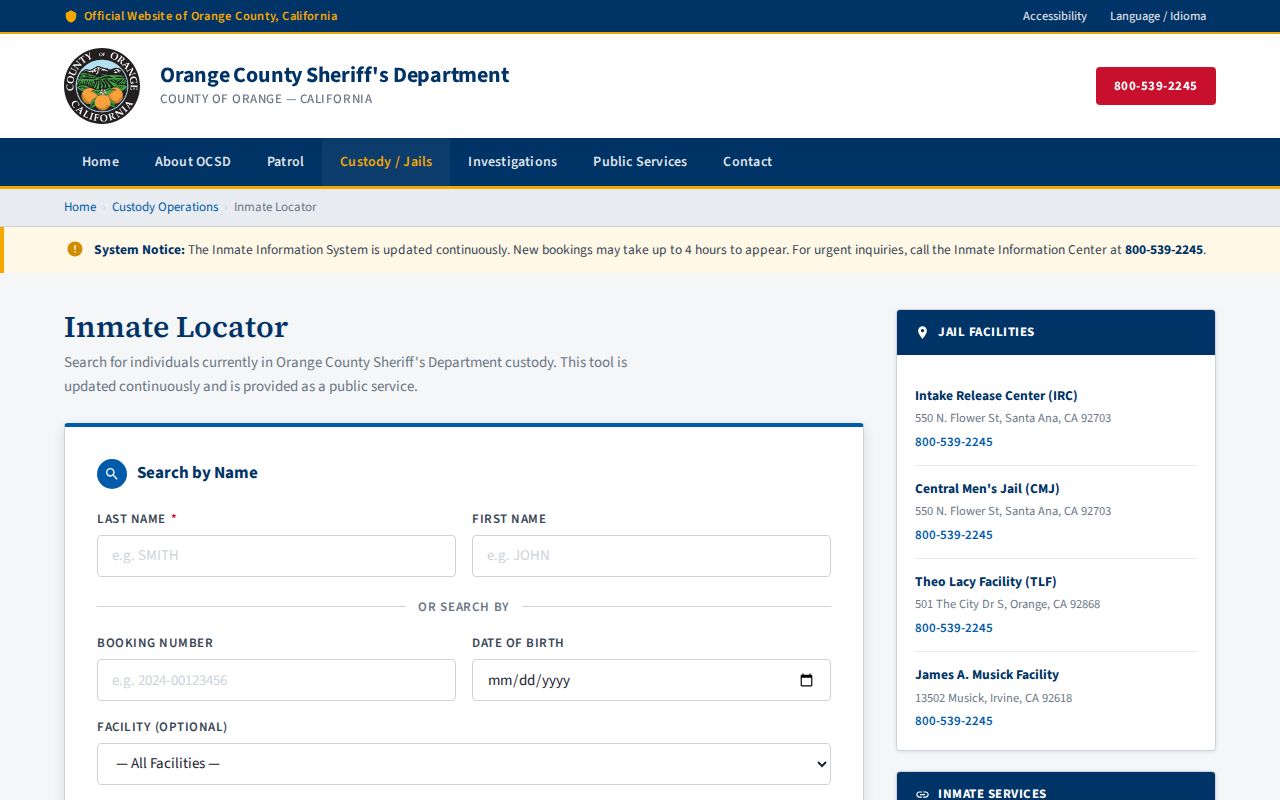
The official custody search is a query tool, not a roster. It returns individual results by name or booking number. No list of people appears. No booking-photo gallery exists there.
Where Orange Arrest Records Appear
Every source reflects a different record state. Official channels should lead. They create and maintain the underlying record. News sites and aggregators can point you to a story or a stale reference, but they prove nothing about current custody or a case outcome. Always match a name, date, agency, and booking or case number against an official record.
| Channel | Photo? | Status | Best use |
|---|---|---|---|
| OCSD locator and portal | No public field observed | Official | Current county custody |
| OCSD arrest log | No photo field documented | Official | Date-based arrests and cite-releases |
| City police logs | Usually no photo in reviewed reports | Official | Agency-specific arrest details |
| Orange Superior Court | No mugshot search | Official | Hearings and disposition |
| Crime Voice, Voice of OC, Patch | Story-specific | News | Selective context, not a roster |
| RecentlyBooked, Mugshots.com, Local Crime News | Varies | Unofficial | Secondary leads that need verification |
Crime Voice keeps an Orange County archive of event-driven police stories. Voice of OC and Patch cover broader justice news. County-local aggregator pages run stale, incomplete, or misclassified. Treat Local Crime News results with extra care. A visible Orange County label can mark a person's home rather than the county of arrest. Some national mugshot brands show no Orange County, California page at all. Their Florida pages are never local. The OCSD online-services index is a handy visual start for official booking, inmate, blotter, and most-wanted services.
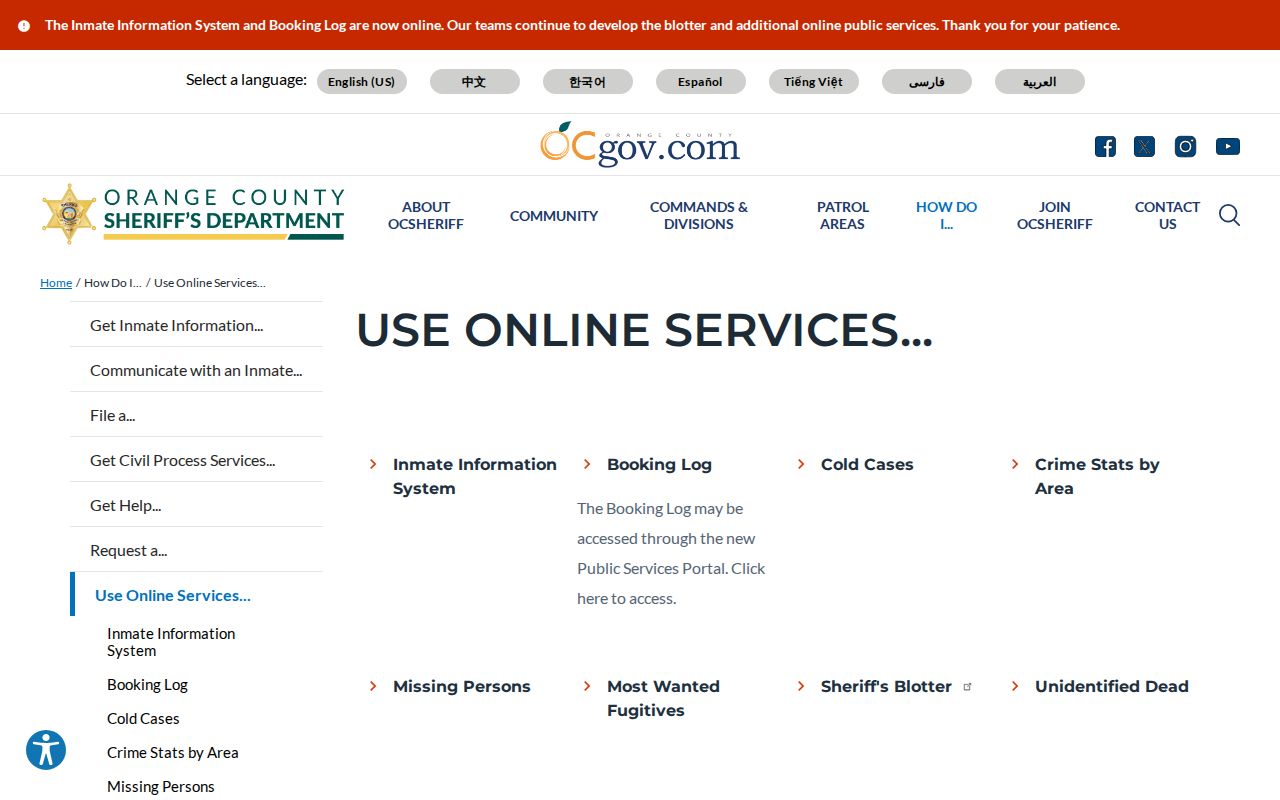
The capture shows the official service menu rather than person-level arrest images.
Recent Arrests by Orange County City
The first paperwork usually comes from the city agency that made the arrest. Custody can move to OCSD afterward, so both levels matter. Each city page here follows that same path. Anaheim Recent Arrests walks through the Anaheim Police Department's rolling log. It also covers the separate city jail. Santa Ana Recent Arrests covers the police department's 30-day PDF report. It also traces the county custody route in the county seat. Irvine Recent Arrests turns to Irvine Police Records. IPD posts no current daily public arrest log.
Orange County Arrest Record Fields
A booking record starts when an agency formally processes an arrested person. It is not the court file. The fields the public can see depend on the custodian. Any legal exemption that applies matters too. From the county service description and the city reports, a few common fields show up again and again.
| Field | What it shows |
|---|---|
| Name and date of birth | Identity details used to separate similar names |
| Booking or local reference number | The agency's identifier for the intake or log entry |
| Arrest date and time | When the arrest was recorded |
| Arrest location | Place reported by the arresting agency |
| Booking type | How the county classified the intake or cite-release |
| Charge section | The alleged law violation at that stage |
| Facility or custody status | Where the person is shown as held, when public |
| Booking photograph | An identification image that may require a request |
These fields can change after booking. Bond is money or another condition used to secure release where allowed. At an arraignment, the court addresses the charges and the arrested person's rights for the first time. A disposition is the court's outcome. A detainer is a hold or request from another authority.
Booking data covers the arrest, not the outcome. The Orange County Superior Court holds the disposition. Court records show what a case finally became. Check there for the full story.
Orange County Mugshots After Arrest
OCSD's public locator displays no booking-photo field. The authenticated services portal is not a public mugshot gallery either. An Orange County mugshot sometimes belongs in an official record. Go to the agency that holds the booking file. For county custody, that usually means OCSD Records. For a city arrest, start with that city's police records unit. Bring the incident, the arrest date, the person's name, and any report or booking number you have.
State custody is a different stage. The CIRIS offender search from the California Department of Corrections and Rehabilitation covers state prison and parole records. It is not a recent county arrest. CIRIS is not a photo gallery either. For an eligible state-prison photograph, CDCR's media and records process is the right path. Federal Bureau of Prisons and ICE locators answer federal or immigration custody questions. Neither replaces an Orange County booking-photo request.
Unofficial sites sometimes keep old photos online long after a person has left custody. Fix the originating government record first. After that, use a publisher's free correction or removal policy. That applies when an entry is sealed, expunged, wrong, outdated, duplicated, or tied to the wrong person.
OCSD Booking Records Requests
The OCSD Information Management and Records page names the CPRA unit and the public counter. For online filing, the current online records request form takes incident details. It mentions secure PDF delivery plus possible fees. Its wording is dated, so confirm the form still works before counting on it. The historical OCSD CPRA guide listed paper copies at $0.15 per page. It also noted the response period then in effect. Fees vary by agency and record type. Get a current quote straight from OCSD.
- Identify the custodian. Use OCSD for a county booking and the arresting city department for its police report.
- Give the full name, approximate date and time, location, incident type, and known booking or case number.
- State the exact record sought, such as the booking sheet, arrest report, or booking photograph.
- Submit through the official form or contact the CPRA unit. Keep the confirmation and request number.
- Review any cited exemption or fee before paying, and use the court file to check the final disposition.
The OCSD public counter sits at 320 N Flower Street, Santa Ana, California 92703. Its listed phone is 714-834-6454. The CPRA unit lists 714-834-3999 and weekday hours from 8:00 a.m. to 5:00 p.m. Records can be withheld or redacted. The grounds include an investigation, a privacy rule, a juvenile restriction, a sealing order, or another law.
Fees depend on the custodian. OCSD's older guidance names a per-page copy rate. Irvine publishes its own schedule for reports and approved photographs. Anaheim lists no current fee on its page. Ask for an estimate before copies are made. Never assume a city price applies to a county record. That variation is a practical reason to contact the office that actually holds the file. The official records page shows the department's records structure and contact channels.
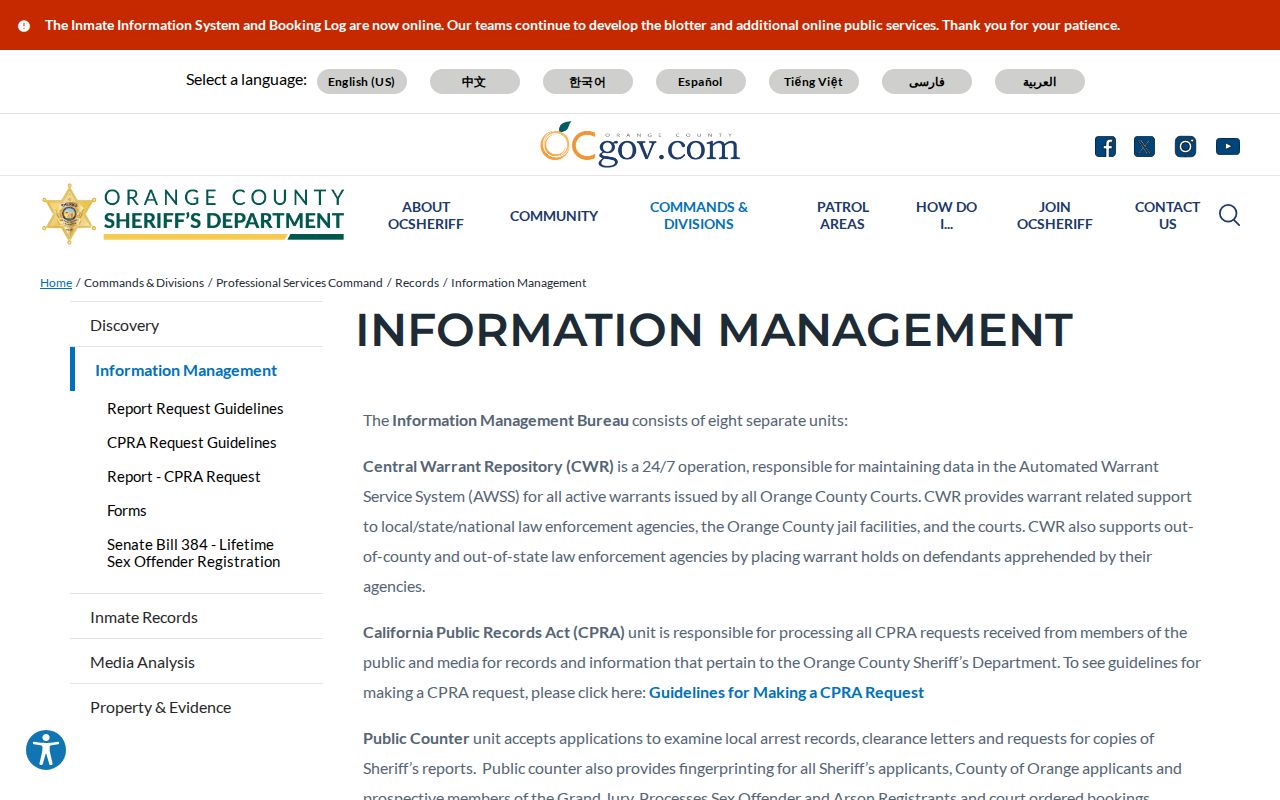
Need an older OCSD arrest? File a booking records request. It answers questions the online roster cannot. Older Orange County arrests sit in these official files.
California Booking Photo Rules
California treats booking photos with unusual care. Government Code section 7923.610 spells out which arrest details a public entity may release. It also shows where exceptions apply. Money sits at the center of the second rule. Civil Code section 1798.91.1 bars publishing a booking photograph while charging the arrested person to remove, correct, or modify it. A public agency may still bill a reasonable fee for an administrative correction. A paid-removal pitch is a business tactic, not an official record remedy.
Social media gets its own limits. Penal Code section 13665 restricts law-enforcement posts of booking photos. It covers people arrested on nonviolent charges. Fugitives, imminent threats, court orders, and urgent circumstances fall outside the rule. An unexpired post should come down within 14 days. The statute also separates social media from an agency's own website or electronic data system.
Sealing and expungement differ too. Sealing restricts access to an eligible arrest record. That can happen through a court order or an automatic process. Expungement is a post-conviction remedy. It does not guarantee instant deletion from every copied index. California Courts offers self-help for an arrest without conviction. The state DOJ explains how sealing orders reach its records. Start with the correct order. Send it to the official custodian. Outside publishers deserve only free correction paths. The official anti-pay-to-remove statute reads in full at the Legislature's code site.
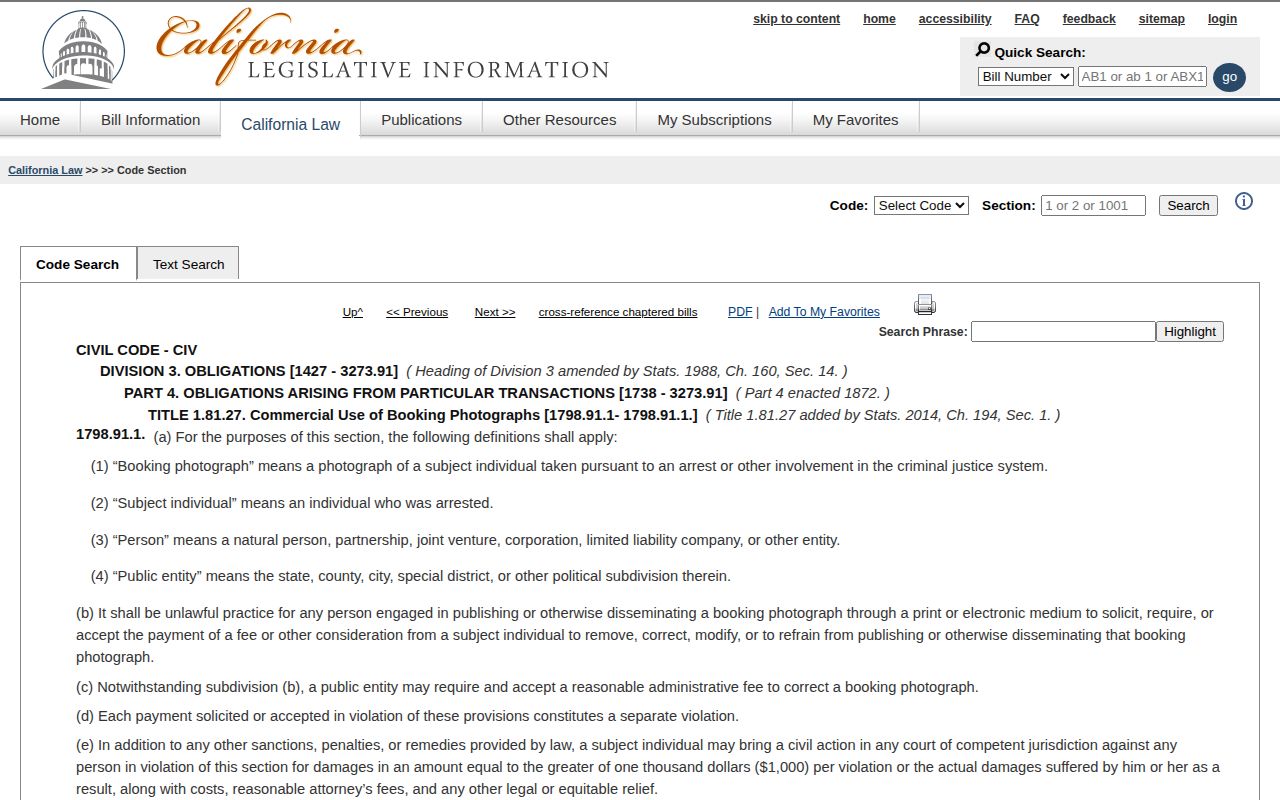
The statute supports a records-first, free-correction approach instead of a commercial removal scheme.
Orange County Warrant Checks
Orange County courts issue the warrants, and OCSD's Central Warrant Repository keeps track of the active ones. The sheriff lists no open public database covering every warrant. So direct questions about a specific warrant to the repository at 714-834-6470, an attorney, or the issuing court. A warrant authorizes an arrest by court order. Bench warrants typically follow a missed court duty. Neither should be resolved through a third-party name search.
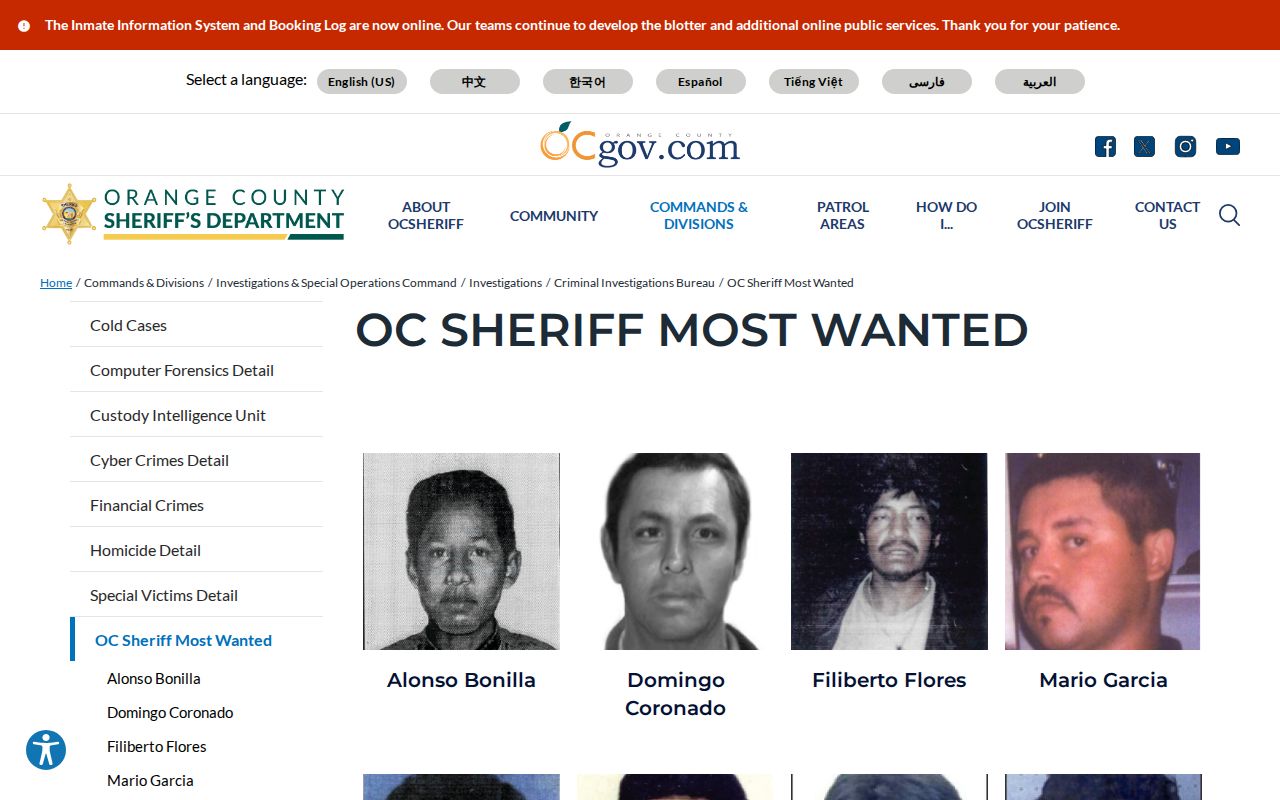
The OC Sheriff Most Wanted page is narrower still. It highlights selected fugitives rather than serving as a complete warrant index, and OCSD publishes no update schedule for it. Never approach a listed person. Call 911 for an immediate threat. Tips can go to Orange County Crime Stoppers through its official submission channel, though reward terms vary and deserve confirmation with the program itself.
Use this Orange County tool for tips only. Never track a person with it. Report what you know, safely. That is its one purpose.
Orange County Court Outcomes
Booking answers one question. Court records answer the rest. After an arrest in Orange County, a person may be released, held in county custody, arraigned, or picked up on another authority's hold. The live jail roster only shows custody. It says nothing about what a judge decided. The Orange County Superior Court criminal case-access system is the next official stop for hearings, filed charges, and case outcomes.
Online data is not the official court record. Sealed and juvenile matters stay restricted. Match a case by number and identity details, since a prosecutor can decline, change, or amend a charge. The disposition shows whether the case ended in dismissal, a plea, a trial, or something else. Certified copies come through the court's copy and search request process, and that final record beats a booking label or an old news clip.
Note: An arrest starts a process; only a court disposition establishes how the filed case ended.
Custody Beyond Orange County
A county search is not a state search. Orange County's roster stops at its own jail. California runs a separate system for prisoners and parolees. CDCR's CIRIS lists a name, CDCR number, age, location, commitment county, admission date, and parole-hearing details. The locator warns that its data can hold errors or lag. No match? CDCR's Identification Unit takes calls at 916-445-6713 on weekdays.
Federal custody runs through another door. The Federal Bureau of Prisons locator covers inmates from 1982 onward and refreshes daily. It offers no photo gallery. The ICE Online Detainee Locator handles current ICE or CBP custody plus some releases within 60 days. It wants an A-number or exact identity details. Juveniles are excluded, and it never replaces OCSD. Detainers add another layer. A detainer means one agency has asked the current custodian to hold or notify it about a person. Confirm that status with the named agencies.
Older Orange County arrest material takes yet another path. The live locator is no archive, and the public arrest log covers a short window. Start with OCSD Records, then the court index and its copy service. For deep history, ask whether a jail register, booking file, or photograph stayed with the county, moved to an archive, or was destroyed under a lawful schedule. The California State Archives' county-records guide lists possible categories, though it cannot promise every Orange County series survives online.